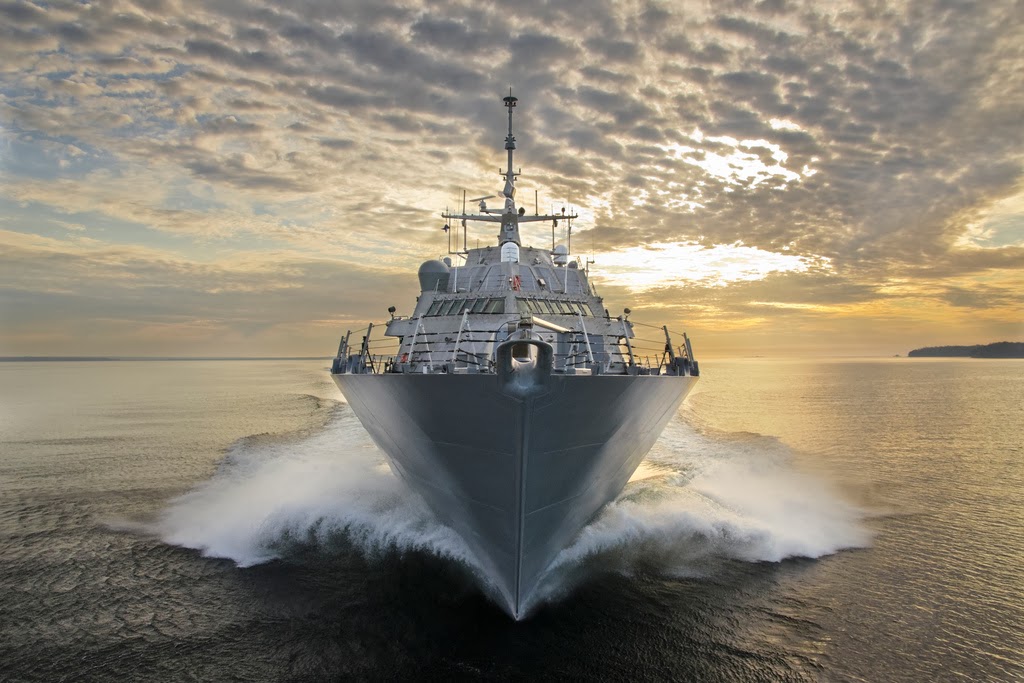
The skilled team of shipbuilders at Lockheed Martin's Marinette Marine shipyard in Marinette, Wis. are hard at work this winter building the USS DETROIT (LCS 7). Earlier this week, the company was awarded contracts to build the seventh and eight LCS Freedom class ships.
Current plans are the DETROIT to be launched in February 2014 and commissioned in the summer of 2015.
USS FREEDOM (LCS 1) is currently underway and will make a port call at Pearl Harbor next week. She departed San Diego on her maiden deployment a week ago with a new camo design on her hull and superstructure.
Friday, March 8, 2013
Tuesday, March 5, 2013
Sunday, March 3, 2013
WORTH READING - PROCEEDINGS ARTICLE BY RADM TOM RODWEN
The first quarter of this year turned out to be in short "busy, for a semi-retired guy." This Sunday afternoon, I'm just getting caught up on some Navy-related professional reading, including the January 2013 of PROCEEDINGS, the monthly professional journal published by the United States Naval Institute. The cover story is by Rear Admiral Tom Rodwen, USN, Director, Surface Warfare Division, N96, Office of the Chief of Naval Operations.
He provides an excellent overview of the challenges faced in the LCS program and status to date. To obtain the full article, you'll need to become a member of the Naval Institute, (I highly recommend the $49 investment in the annual membership fee!) Click here to read a short authorized summary from the usni.org.
Let me offer up some comments on this excellent article:
RADM Rodwen comments:
Other key points from his article:
First and foremost, LCS is a warship. Our emphasis today is on ensuring LCS’s successful Fleet introduction and performing those three previously mentioned warfare missions proficiently in a hostile environment. The ships have remained consistent with our original assessments and recurring analysis of the warfighting requirements of today and tomorrow. The ship attributes and capabilities include:
His article concludes with the following observations:
We envision two or three LCSs operating with carrier strike groups or amphibious ready groups. For example, if we have three LCSs in the Persian Gulf in addition to three DDGs from a strike group, the DDGs can fulfill other critical missions, including ballistic-missile defense, intelligence collection, and air defense. Meanwhile, one SUW mission package-capable LCS conducts anti-piracy patrols, a second MCM mission package-capable LCS surveys Q-routes in the Strait of Hormuz, and a third LCS conducts patrols in the International Recognized Transit Corridor. 6
I encourage you to become a member of the U.S. Naval Institute, as well the the Navy League of the United States. Both are excellent organizations and will add to your ability to support our young men and women of the United States Navy who serve our nation and protect our freedoms.
He provides an excellent overview of the challenges faced in the LCS program and status to date. To obtain the full article, you'll need to become a member of the Naval Institute, (I highly recommend the $49 investment in the annual membership fee!) Click here to read a short authorized summary from the usni.org.
Let me offer up some comments on this excellent article:
RADM Rodwen comments:
Three points must be made up front.
First, the LCS was conceptualized nearly a decade ago to address
warfighting capability gaps that still exist today: littoral surface warfare
(SUW), littoral antisubmarine warfare (ASW), and mine countermeasures (MCM).
Second, LCS remains the most economical available ship to address these gaps
while providing global forward presence. Finally, we have very little
experience with modularity and how to man, train, equip, maintain, modernize,
sustain, and tactically employ this ship. The Navy is incorporating lessons
learned with a sober sense of the necessary cultural, organizational, and
operational changes required to ensure that LCS is successful.
The LCS program has faced many challenges since conceived and the first two ships were designed and built under competitive contracts. But with Friday's deployment of USS FREEDOM (LCS 1), the Navy has achieved an important milestone on adding this highly effective warship to our fleet. Although still in "development" as far as crew size, modular war-fighting packages and operational experience, the dedication of the Navy leadership, contractor teams and the Blue and Gold Crews of all LCS ships is to be greatly admired.Other key points from his article:
First and foremost, LCS is a warship. Our emphasis today is on ensuring LCS’s successful Fleet introduction and performing those three previously mentioned warfare missions proficiently in a hostile environment. The ships have remained consistent with our original assessments and recurring analysis of the warfighting requirements of today and tomorrow. The ship attributes and capabilities include:
Speed and Endurance: The ship would have to be quick and agile with
low speeds for most mission operations, economical speeds for transits, and
high-sprint speeds of 40–50 knots. High-sprint speeds were desirable for
responsive mobility, increased search volume, and threat evasion. Navy leaders
were willing to trade endurance to achieve those speeds.
Unmanned Systems and Modularity: LCS was envisioned to employ a variety of
manned and unmanned surface, air, and undersea vehicles capable of real-time
data exchange. Its modular mission remains the heart and key strength of the LCS
concept.
Mid-life combat-system upgrades necessary to
pace evolving threats are usually intensive and expensive. LCS’s open
architecture (OA) combat system and modular design allow for accelerated,
comparatively cost-effective, noninvasive retrofit and upgrades, and the
incorporation of emerging technologies over the course of the ships’ 25-year
expected service lives.
Self-Defense and Survivability: LCS is envisioned to operate independently,
with a surface-action group, or in support of a carrier/expeditionary strike
group. It will operate with other ships in higher threat situations, relying on
the anti-air warfare capabilities of other Fleet assets with the ship’s
survivability characteristics linked to self-preservation as opposed to continued
warfighting.
Cost: Affordability was a primary programmatic concern for LCS. In
2002, the Navy was struggling to contain shipbuilding cost growth. Therefore,
both the Office of the Secretary of Defense (OSD) and leaders wanted LCS to be
a low-cost ship built in numbers. OSD expected the Department of the Navy to
buy at least three missionized LCSs for the price of one Arleigh Burke –class
destroyer, equating to a target cost of approximately $400 million per ship,
including mission packages (in Fiscal Year 2005 dollars), whereas the Navy
wanted $250 million per ship without a mission package. 3 A “threshold” cost of $400 million and
an “objective” cost of $250 million presented significant challenges to the
requirements community and industry teams.
His article concludes with the following observations:
We envision two or three LCSs operating with carrier strike groups or amphibious ready groups. For example, if we have three LCSs in the Persian Gulf in addition to three DDGs from a strike group, the DDGs can fulfill other critical missions, including ballistic-missile defense, intelligence collection, and air defense. Meanwhile, one SUW mission package-capable LCS conducts anti-piracy patrols, a second MCM mission package-capable LCS surveys Q-routes in the Strait of Hormuz, and a third LCS conducts patrols in the International Recognized Transit Corridor. 6
In short, the LCS is essential to filling the
warfighting gaps in the littorals. This ship has a very clear purpose—to
fulfill defined, enduring, and Joint Requirements Oversight Council-approved
warfighting gaps. Concurrently, fiscal realities dictate that we need LCS
because it is a cost-effective and capable solution. The Navy is proceeding
responsibly and enthusiastically in putting these ships to sea rapidly to meet
our requirements around the world. Combatant commanders are eager for this
addition to the joint force, and leadership remains committed to the success of
this program. We are regaining our track at full speed and will continue to
refine our course as appropriate to meet the Navy’s operational needs.
I encourage you to become a member of the U.S. Naval Institute, as well the the Navy League of the United States. Both are excellent organizations and will add to your ability to support our young men and women of the United States Navy who serve our nation and protect our freedoms.
Saturday, March 2, 2013
USS FREEDOM (LCS 1) UNDERWAY FOR SOUTHEAST ASIA
FLIGHT QUARTERS! -- USS FREEDOM LCS (1) lands
her MH- 60 Sea Hawk helicopter after departing San Diego.
SAN DIEGO, March 1, 2013 -- USS FREEDOM (LCS 1) sailed today on her maiden deployment to Southeast Asia and her forward deployed base in Singapore.
According to a Navy press release, during the eight month deployment, Freedom will complete the first of many planned rotational deployments to the Western Pacific for the new LCS platform. Freedom will conduct maritime security operations with regional partners and allies. After making initial port visits in Hawaii and Guam, Freedom is expected to participate in the International Maritime Defence Exhibition and Conference (IMDEX) in Singapore and in select phases of the Cooperation Afloat Readiness and Training (CARAT) exercise series in Southeast Asia.
Freedom's "Gold" crew set sail under commander of the ship's Gold Crew commanding officer, Commander Timothy Wilke, USN.
During this first deployment of the Navy's first Littoral Combat Ship, Freedom will demonstrate her operational capabilities and allow the Navy to evaluate crew rotation and maintenance plans. Fast, agile, and mission-focused, LCS platforms are designed to employ modular mission packages that can be configured for three separate purposes: surface warfare, mine countermeasures, or anti-submarine warfare.
"One of the things we're working on is communicating what we can and can't do with this ship," said Wilke in remarks quoted in the news release. "We need to figure out how to best employ littoral combat ships in our Navy and figure out how we can best use them when working with partner nations."
Following initial port visits in Hawaii and Guam, Freedom is expected to participate in the International Maritime Defence Exhibition and Conference (IMDEX) in Singapore and in select phases of the Cooperation Afloat Readiness and Training (CARAT) exercise series in Southeast Asia.
U.S. Pacific Fleet Commander, Admiral Cecil Haney, was also commented on Freedom's deployment: "Freedom's maiden deployment is another clear signal of the Navy's enduring commitment to maintain security and stability in the vital Asia-Pacific region," said Haney. "Rotationally deploying our new littoral combat ships improves our warfighting capability and directly supports the Navy's rebalance strategy to the Asia-Pacific."
Freedom's "Gold" crew of 91 sailors include mission package personnel and an aviation detachment to operate an embarked MH-60 helicopter. Midway through Freedom's deployment, a crew swap will be conducted with her "Blue" crew, commanded by Commander. Patrick C. Thien.
Freedom will remain homeported in San Diego throughout this rotational deployment to Southeast Asia. Freedom's Facebook page has seven photos posted of underway operations after departing San Diego.
Thursday, February 28, 2013
USS FREEDOM (LCS 1) DEPLOYS TOMORROW
Fair winds and following seas to the captain, officers, chiefs and crew of USS FREEDOM (LCS 1) as they set sail tomorrow from San Diego to her forward operating base in Singapore.
Here's an excellent story posted a few hours ago:
http://defense.aol.com/2013/02/27/navy-littoral-combat-ship-sails-for-singapore-with-new-camo-pain/?a_dgi=aolshare_linkedin&goback=%2Egde_53927_member_218213054
v/r
CAPT John McCandless, USN (Ret)
Here's an excellent story posted a few hours ago:
http://defense.aol.com/2013/02/27/navy-littoral-combat-ship-sails-for-singapore-with-new-camo-pain/?a_dgi=aolshare_linkedin&goback=%2Egde_53927_member_218213054
v/r
CAPT John McCandless, USN (Ret)
Wednesday, February 27, 2013
MEET THE PCO OF USS DETROIT (LCS 7)
Commander
Michael R. Wohnhaas, USN, has been selected as the PCO (Prospective Commanding
Officer) of USS DETROIT (LCS 7). A
native of Barnesville, Pennsylvania, he is a 1996 graduate of the United States
Naval Academy.
| Official Portrait of Michael R. Wohnhaas prior to his promotion to the rank of Commander |
Currently
assigned to the Future Ships Requirements (LCS and DDG 1000) Office at Commander, Naval Surface Force Pacific (SURFPAC)
in Coronado, Calif., he has held many assignments as a surface warfare
officer.
His sea duty assignments
include: Communications, Main Propulsion, and Gunnery Officer on USS ANZIO (CG
68) and Damage Control Assistant on USS SUPPLY (AOE 6). As a department head he served as Combat
Systems Officer in USS VANDEGRIFT (FFG 48) forward deployed to Yokosuka, Japan;
and as Force Protection, Combat Systems, and Training/Readiness Officer for
Commander, Destroyer Squadron TWO SIX.
He was the plankowner Executive Officer of USS WILLIAM P LAWRENCE (DDG
110).
Ashore CDR
Wohnhaas taught Damage Control and Gunnery at the Surface Warfare Officers
School Division Officer Course in Newport, RI.
More recently he served as the Maritime
Operations Officer at the Joint Forces Command Joint Enabling Capabilities
Command (JFCOM JECC), a deployable headquarters element, where he deployed to
Iraq and Afghanistan.
In 2007 CDR
Wohnhaas earned a Master of Military Arts and Sciences degree in Strategy from
the U.S. Army Command and General Staff College, Fort Leavenworth, KS, where he
also earned Joint Professional Military Education (JPME) Phase I. He completed JPME Phase II at the Joint
Forces Staff College, Norfolk, VA in 2009 and is a Joint Qualified Officer.
His personal awards include the Joint Service Commendation Medal (three awards), Navy-Marine Corps Commendation Medal (three awards), and the Navy Achievement Medal.
The USS DETROIT (LCS 7) BLUE & GOLD COMMITTEE, as well as all members of the Metropolitan Detroit Council, Navy League of the United States, looks forward to welcoming CDR Wohnhaas to Detroit soon. If you'd like to become a member of the Navy League and the "METDET" Council, let me know by sending me an e-mail at j.mccandless@comcast.net Our Council added 56 new members this past year and we have many programs planned to support our Navy and other other sea services.
Subscribe to:
Posts (Atom)


